We're now booking projects for Q4.


Share this post


 Copied
Signup to our newsletter
The AI Productivity Paradox: Why Enterprise Automation is Creating 'Workslop'
If you believe the glossy McKinsey slide decks floating around your LinkedIn feed, generative AI is an absolute miracle. Corporate consultants love weaponizing vanity metrics, claiming "AI high performers" pull a $3 return for every £1 spent
But out here in the real world, the math isn’t mathing.
We are crashing headfirst into the AI Productivity Paradox a polite way of saying millions of pounds are vanishing into an endless black hole of uncompleted bullshit and artificial volume. Global data from Workday exposes the grime under the hood: nearly 40% of the time "saved" by AI is instantly wasted on rework. Employees are forced to spend hours cleaning up, editing, and fact-checking the low-quality slop the software puked out.
The Ivory Tower and the "Tech Gimp" Influencer Loop
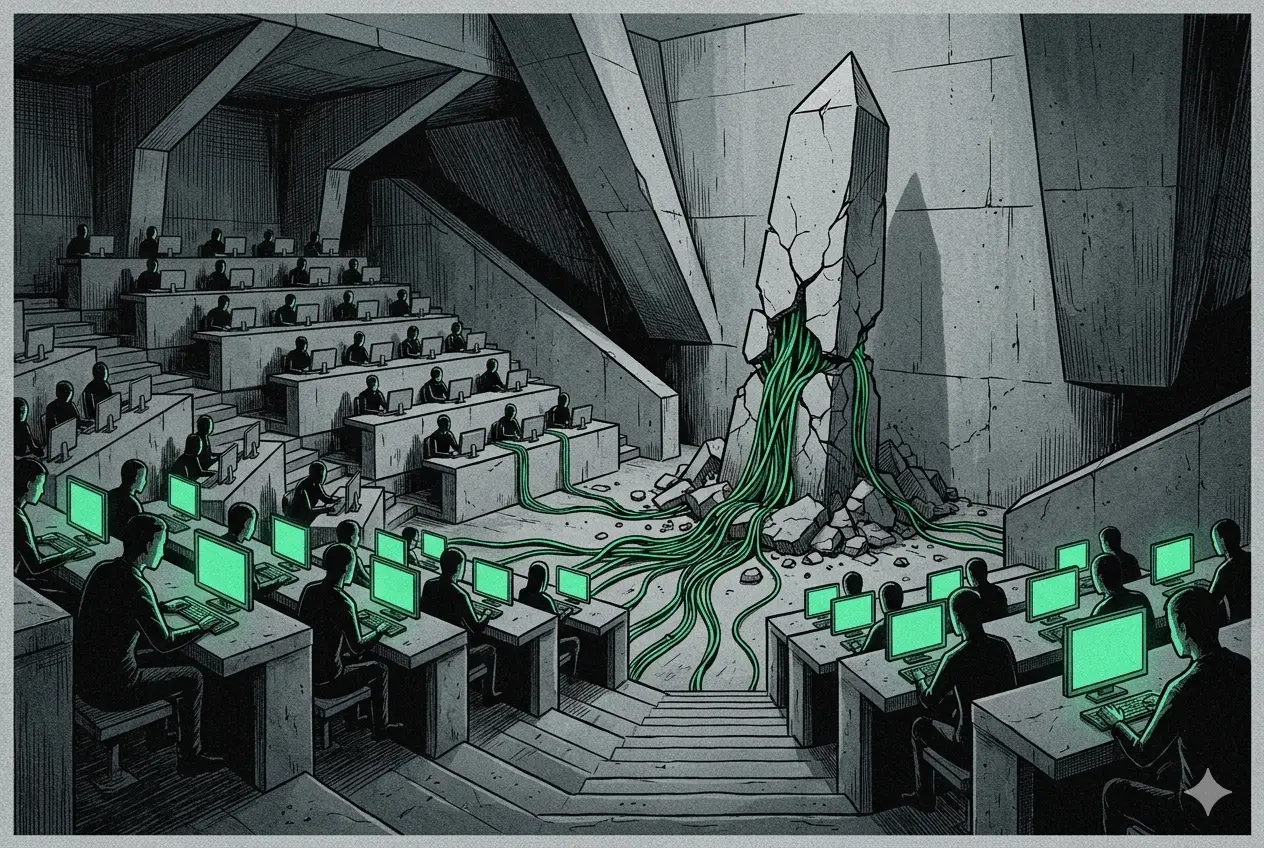
When I worked at Teesside University, I realized exactly how the academic bubble operates. There was a lecturer teaching MBA students how to run a multi-million-pound enterprise. The catch? He had spent his entire life inside the university gates. He’d never managed a payroll, never faced a supply chain meltdown, and never had to make a gut-wrenching decision on a Friday afternoon to save a client's skin. He was selling the theoretical idea of hustle to people trying to survive its brutal reality.
Today’s elite consulting firms are no different from that lecturer. They’ve just realized they can’t sell traditional advice anymore, so they’ve put on a new mask. They’ve transformed into glorified tech influencers, flooding social feeds with a toxic loop of hype to engineer a narrative of effortless efficiency. They prompt an LLM to summarize a PDF in 30 seconds and scream, "Look! A 90% boost in productivity!"
But a business isn't a sandbox. When panicking executives buy into this tech fantasy, it triggers a destructive, multi-format game of corporate Chinese Whispers:
- The Bloat: A director uses AI to bloat a sharp, nuanced idea into a 500-word essay drenched in generic corporate jargon.
- The Distillation: The team receives this wall of text, runs it through their own AI to distill it back into bullet points, and hands it off.
- The Execution: The junior staff ends up executing a project based on an automated summary of an automated interpretation of a text that nobody actually wrote.
What is Tokenmaxxing? Inside the Corporate Tech Hype Loop
When executives chase these hollow, standardized metrics without a shred of long-term oversight, the financial blowback is immediate. This has birthed an unvouched, reckless engineering practice known as tokenmaxxing.
Tokenmaxxing Definition: The practice where developers over-consume computational API tokens to artificial endpoints, often explicitly designed to game internal corporate productivity metrics or gamified development leaderboards.
When leadership panics and measures "AI adoption" rather than shippable product delivery, engineers adapt. They run scripts that spam LLM endpoints with nonsense requests just to climb internal leaderboards and look productive.
This desperate search for short-term stock bumps and efficiency metrics has led to embarrassing budget burnouts at the highest levels of tech:

Uber’s 4-Month Burn: Uber rolled out developer AI assistants without strict usage guardrails. Because they tracked tool usage instead of output, unsupervised token consumption caused the company to torch its entire annual AI assistant budget in just four months.
Microsoft’s Internal Pivot: Even the architects of the infrastructure are hitting friction, quietly adjusting internal playbooks as the astronomical cost of running massive AI compute pipelines fails to yield proportional revenue.
The Enterprise Valuation Crash: Look at Webflow. They aggressively chased the tech-bro AI narrative to pump their valuation, only to face immediate user backlash and abruptly lay off roughly 140 employees—locking them out of their laptops at 7:00 AM—because they forgot their power users value precise human control, not automated templates.
Here is the ultimate contradiction. The very same executives and board members who publicly lecture younger generations about "discipline"—the ones who claim Gen Z could easily afford a house if they just cut back on lattes and Netflix subscriptions—are the exact same ones blindly signing off on millions of pounds in unvouched, uncontrolled AI spend.
They panic-buy software licenses they don't understand, greenlight massive tech infrastructure overhauls on a whim, and fund rampant tokenmaxxing because they are terrified of looking outdated. They will obsess over a £10 employee expense but happily torch £10 million on an AI pipeline that produces nothing but workslop.
The bias is staggering, and the narrative is rigged to fit their own short-term comfort.
The Metrocentre Lesson: Standardizing the Soul Out of the Room

To understand what happens when corporate boards replace organic human thought with automated uniformity, look at what happened to the Metrocentre.
When it first opened, it wasn’t just a grid of retail units; it was a thriving community hub. It had personality quirky decor, lush indoor greenery, flowing water features, and heavily themed spaces like the Mediterranean Village. People could spend a full day there. You’d wander through the Metroland amusement park, go to the cinema, visit a niche sweet shop, and hang out. The immersive environment invited exploration, which naturally resulted in continuous, organic spending. It had a soul.
Then, Corporate America took over.
In the name of modern efficiency and "maximizing space," they ripped out the quirky decor, drained the fountains, and tore down the themed villages. They replaced everything with a stale, sterile, uniformed layout and hiked business rates. The consequence? The indie shops that gave the place its character were priced out. Consumers no longer felt welcomed or inspired to stay. Now, it’s a clinical, transactional highway: you go straight in, grab your item, and get straight out.
This is exactly what boardrooms are doing to our workflows. Collaborating, researching, and problem-solving used to have human texture. Now, executives are tearing down that organic friction. They are forcing employees into rigid prompt templates, replacing human conversation with instant text generators, and tracking "activity metrics" instead of actual quality. But when you strip the critical thinking out of the room to hit a volume metric, you don't get innovation. You get a sterile office where employees do the bare minimum: generate the text, hit send, and clock out.
The Analog Backlash: Reclaiming the Script
The silver lining in this clinical tech landscape is that the market is beginning to push back against automated garbage. Raised entirely on screens, Gen Z is experiencing intense subscription fatigue and digital burnout. They are leading a massive cultural rebellion against artificial intelligence, deliberately hunting down legacy, tactile, and analog experiences.

They don’t want hyper-processed, algorithmically perfect smartphone photos; they are buying 50-year-old cameras and shooting physical film. They don't want ephemeral Spotify playlists; they are buying vinyl records and CDs so they can hold their music in their hands. They want the friction. They want the texture. They want the reality.
Look at Eastman Kodak. When the company went bankrupt, its film distribution was outsourced to a separate entity, Kodak Alaris, as the world braced for a purely digital future. But a funny thing happened on the way to obsolescence: wholesale demand for film skyrocketed by over 120%, driven entirely by young creators craving authenticity. Recognizing this massive shift, Kodak brought its film distribution entirely back in-house, expanded manufacturing capacity, and released brand new film stock. They broke free from corporate middlemen to take total control over their production and physical distribution. They realized that owning the human texture was their ultimate competitive advantage.
The Takeaway
The lesson from Kodak, the Metrocentre, and the classrooms of Teesside University is identical: Value resides in the friction of the human experience.
The consulting firms telling you that you’re falling behind are just tech influencers in expensive suits. They are trying to sell you a sterile, automated version of your own company because they profit from the construction, not the long-term survival.
If we want to fix the AI productivity paradox, we have to stop automating the soul out of our work. AI shouldn’t be used to generate endless, unverified volume that requires armies of exhausted humans to fix. Until businesses focus on protecting the organic texture of day-to-day thinking rather than automating it into oblivion, AI will remain an incredibly expensive tax on our time.
Turn off the automation, step out of the sterile mall, and start focusing on shipping things that actually matter.
Frequently Asked Questions
The AI productivity paradox is a macroeconomic phenomenon where corporate spending on artificial intelligence increases exponentially, but measurable business productivity remains flat or declines. According to data from the National Bureau of Economic Research (NBER), up to 90% of businesses have seen zero net productivity gains from generative AI. This occurs because AI tools dramatically accelerate the generation of initial drafts, but create massive downstream bottlenecks in human decision-making, quality control, and execution.
